


Dating advice
All articles
Dating apps
Relationship
Tinder
November 6, 2024
How to Rizz a Girl Up: 6 Expert Tips for Instant Charm
Read more 

 Blog
Blog

You walk into a room, and people respond to you pretty quickly. Your humour lands, your presence feels warm, and your confidence comes through clearly. Conversations flow, and attraction builds without effort, almost naturally.
Then you open a dating app, and the experience shifts completely. Matches feel limited, replies slow down, and conversations lose momentum early. You start to question what changed, even though nothing about you feels different.
This gap between offline attraction and online dating can feel confusing at first. It seems like your personality should carry over, yet the results say otherwise.
Here’s the key shift to understand. Attraction in real life gets experienced, yet on apps, it gets interpreted.
That means your personality is not the issue here. The problem lies in how your personality gets presented and perceived digitally.
This article breaks down what disappears behind the screen, why it happens, and how to fix it in a way that reflects who you are more accurately.

Attraction works through very different systems depending on the environment. Offline, it builds through movement, timing, and emotional feedback in real time. Online, it depends on static signals, quick judgments, and limited context.
Here’s how the difference plays out in practice:
| Offline Attraction | Online Dating |
| Energy and presence | Photos and text |
| Real-time reactions | Delayed responses |
| Conversation flow | Fragmented chat |
In person, people pick up on subtle cues almost instantly. Your tone, your pacing, and your reactions create a full experience.
On dating apps, those cues disappear, and users rely on snapshots instead. A few photos and short lines of text must carry the full weight of perception.
This creates a shift that many people underestimate. Attraction offline feels immersive, yet online it becomes interpretive.
Someone meeting you face-to-face experiences your personality directly. Someone scrolling through your profile builds assumptions from limited signals.
This explains why offline attraction and online dating can feel disconnected. The system changes, and your strengths need translation rather than assumption.
A large part of the attraction depends on signals that do not survive digital formats. These signals shape how people feel around you, yet apps cannot carry them.
Here’s what disappears most clearly:
In real life, these elements work together to form a strong impression. They help people feel your personality rather than analyse it.
On apps, none of these signals show up in full form. Users rely on visuals and text alone, which reduces depth significantly.
For many men, these missing elements are their strongest advantages. Their charm lives in interaction, yet their profile cannot display it directly.
This gap explains why results drop despite a strong in-person appeal.
This is usually the moment it starts to feel a bit clearer that the parts of your personality that work best in real life are the exact ones apps struggle to show.
That’s where Flirtist can help. We show how your profile actually translates those signals, not just what you think you’re putting across.
If you want to check where things might be getting lost, you can find out what’s not translating on your profile and see what’s missing right now.
Energy in dating refers to presence, confidence, and emotional impact. It shapes how people respond to you without needing explicit explanation.
In person, energy shows through naturally during interaction. You speak, react, adjust, and create momentum as the conversation develops.
On apps, this energy needs conversion into visible signals. Without that translation, your profile can feel flat or incomplete.
Here’s how the contrast tends to appear:
In person: You smile, tease lightly, and respond with confidence. The interaction feels engaging and dynamic.
On your profile: Photos look neutral, bio feels generic, and tone lacks personality.
In messaging: Replies become cautious, structured, and slightly restrained.
This creates a mismatch that affects perception early. Your real personality exists, yet the app version feels diluted.
Energy does not disappear; it just fails to transfer clearly. Improving results depends on converting that energy into visible cues.
Dating apps rely on rapid decisions driven by limited information. Users scroll quickly, making judgments within seconds of viewing a profile.
The process usually follows a simple sequence:
Photo → Bio → Swipe
Your photos create the first impression almost instantly. They signal confidence, lifestyle, and overall presence.
Your bio adds context, shaping how people interpret those images. It either reinforces interest or weakens it further.
The swipe decision happens before any conversation begins. At that point, your personality has not yet entered the interaction.
This creates a key limitation in online dating. You get evaluated before you get the chance to express yourself.
Strong in-person traits cannot compensate at this stage. Only visible signals influence the outcome early on.
This explains why results feel inconsistent with real-life experiences. Your personality remains intact, yet it has not been communicated effectively yet.
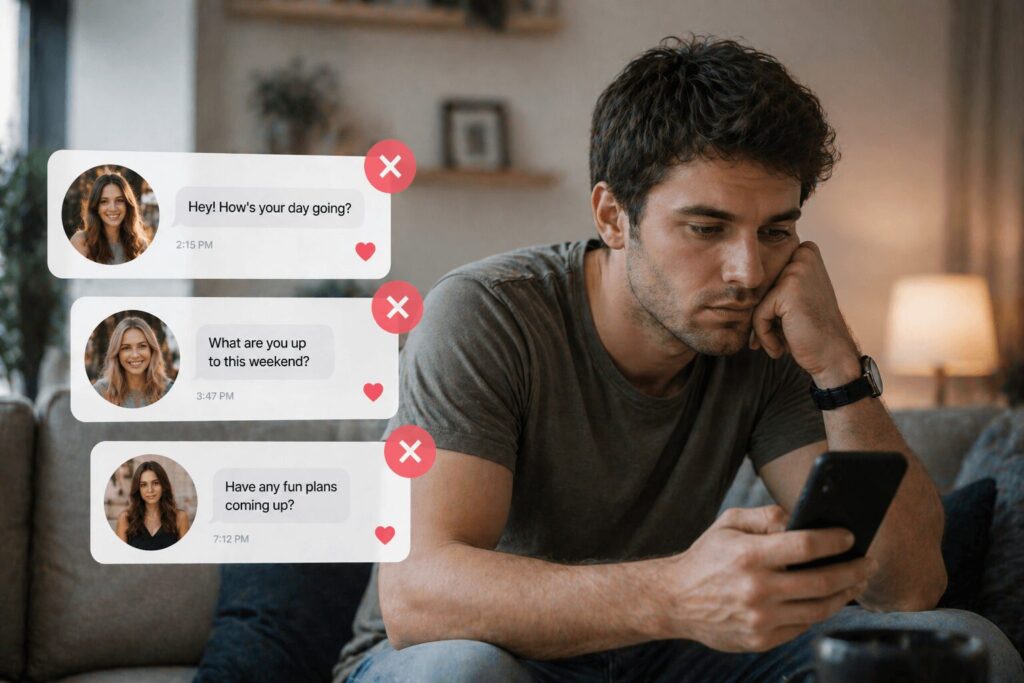
Many profiles fail at the earliest stages without obvious awareness. Small issues combine to reduce interest before conversations begin.
Here are the most common drop-off points:
These mistakes rarely feel serious individually. Together, they create a profile that blends into the background.
Here’s how that difference looks in practice:
Before: “Hey, how’s your week going?”
After: “You seem like someone who has a go-to weekend ritual, what’s yours?”
Before: “Just a normal guy who likes music and travel”
After: “Weekends usually mean coffee hunts, random playlists, and finding excuses to leave the house”
The second version creates curiosity and personality immediately. They offer a glimpse into behaviour rather than vague statements.
Interest depends on specificity and tone from the start. Without those elements, matches lose momentum before they begin.
Once a match happens, attraction shifts into communication. Messaging replaces in-person interaction as the primary driver.
This creates a new challenge for many users. Tone becomes more important than the actual content of the message.
Here’s how that difference appears:
Flat message:
“Hey, what do you do for fun?”
Engaging message:
“You strike me as someone who either plans everything or goes completely spontaneous, which one wins?”
The second message creates engagement through tone and framing. It invites a response rather than asking a standard question.
Overthinking tends to reduce this effect significantly. Messages become structured, cautious, and slightly detached.
Natural tone feels conversational and adaptive. It mirrors how you would speak during a real interaction.
Success in messaging comes from maintaining that natural rhythm. The closer your messages feel to a real conversation, the stronger the response.
At this point, it’s pretty common to realise your messages feel normal to you, yet they might be coming across a little flatter than intended.
That’s exactly where Flirtist comes in, breaking down your tone and phrasing so you can see what feels engaging and what quietly loses momentum.
You can take our dating profile quiz to get a quick read on how your messaging style is landing right now.
Closing the gap requires intentional adjustments across three areas. Each one helps translate your personality into a format apps can display.
Photos need to show presence rather than just appearance. Use images that capture expression, movement, and context. Avoid overly posed shots that reduce authenticity slightly.
Your bio should reflect behaviour, not just traits. Focus on how you spend time, what you enjoy, and how you think. Short, specific lines perform better than broad descriptions.
Messages should feel like extensions of real conversation. Use curiosity, light playfulness, and clear intent. Avoid over-editing responses, which removes personality gradually.
This process does not require changing who you are. It focuses on translating existing traits into visible signals.
AI tools can support this process efficiently. They help shape tone, structure, and clarity without replacing your voice.
Flirtist works as a bridge in this context. It helps convert your real-world personality into messages and profiles that reflect it accurately.
Getting matches is only part of the outcome. Turning those matches into real interactions requires consistency.
Here are key principles to follow:
Consistency builds trust across the interaction. If your tone shifts too much, it creates uncertainty.
The goal is to maintain the same energy from start to finish. Your profile, messages, and real-life presence should feel connected.
When that alignment exists, conversations progress more smoothly. Matches feel more natural, and transitions happen with less resistance.
If you feel a gap between offline attraction and online dating, you are not alone. Many people experience strong real-world connections, yet struggle to reflect that online.
The key point remains clear. Your personality is not the issue here.
What needs adjustment is how that personality gets presented digitally. Once that translation improves, results begin to align more closely.
Flirtist helps close that gap by shaping profiles and messages more effectively. It turns your natural strengths into signals that dating apps can display clearly.If you want clarity on what is missing, you can find out what’s not translating on your profile by going straight in and taking the Flirtist dating profile quiz, giving you a clear path to better matches and stronger conversations.


 Take this 2-min test
Optimize your profile
Get better dates
Take this 2-min test
Optimize your profile
Get better dates 
Join 304,617+ happy users